
Germany vs USA Post-Study Work Visa (2026 Guide)

Contents
When you're choosing where to study abroad, it's not just about the university name or the country hype. For many Indian students, the big question is: What happens after graduation? Can you stay? Can you work? Can you build a future there?
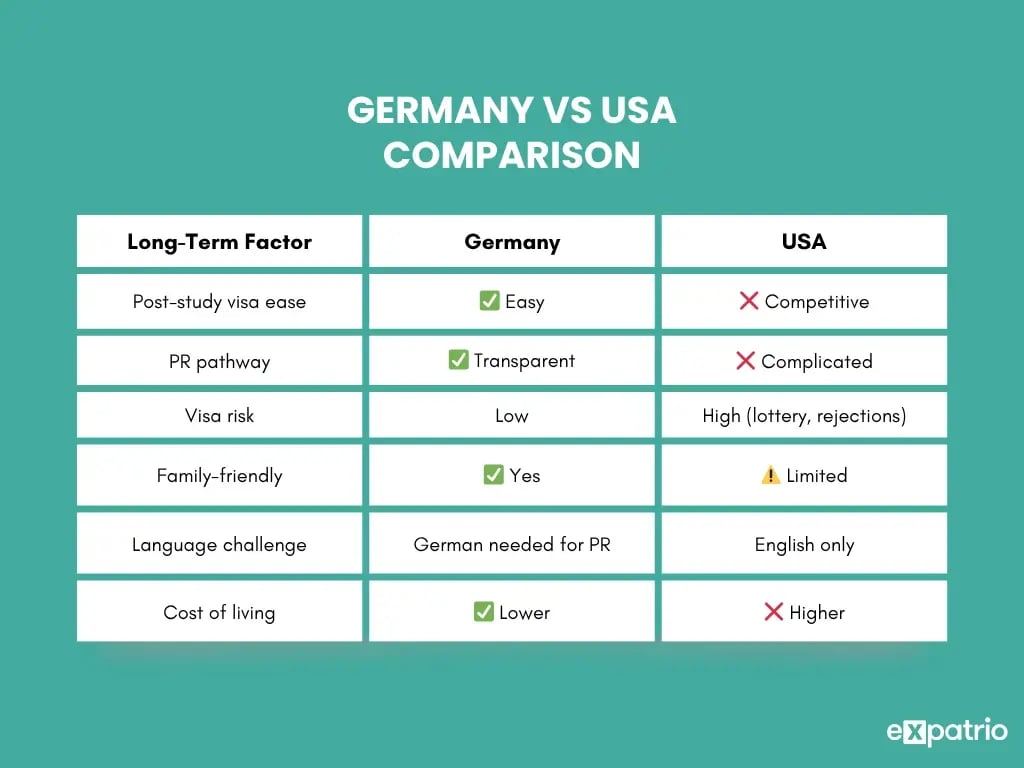
That's where Germany's post-study work visa and the USA's OPT system come in. The difference? Germany gives you 18 months to find a job with no lottery and no employer sponsorship required. The USA makes you compete in a lottery with only a 25% chance of staying beyond your OPT period.
Let's break down what each country offers after your degree so you can make the smart, long-term choice.
Germany's 18-Month Post-Study Work Visa: What You Need to Know
Germany's post-study work visa (officially called the "residence permit for job seekers") gives international graduates 18 months to find skilled employment after finishing their degree at a German university. Here's what makes it special:
No Lottery Required
Unlike the USA's H-1B system, there's no cap or random selection. Every graduate who meets the basic requirements qualifies.
No Employer Sponsorship Needed
You can apply for the job seeker visa on your own – you don't need a company to sponsor you upfront.
Work While You Search
You're allowed to work full-time in ANY job while searching for a position in your field of study. This means you can support yourself and gain German work experience.
Direct Path to EU Blue Card
Once you secure a qualified job paying at least €45,934.20/year (for shortage occupations like engineering, IT, healthcare) or €50,700/year (standard), you can switch directly to an EU Blue Card.
Fast Track to Permanent Residency
With an EU Blue Card, you can apply for PR in just 21 months if you have B1 German, or 33 months without language skills.
What Happens After Graduation: Germany vs USA
🇩🇪 Post-Study Work Visa Germany for Indian Students
- After finishing your studies at a public university in Germany, you automatically qualify to apply for an 18-month job seeker visa.
- You don't need a job offer to apply.
- You're allowed to work full-time in any job while you search for a role in your field of study.
- No employer sponsorship is needed for the job seeker visa.
- Once you find a qualified job, you can apply for the EU Blue Card with a minimum salary of:
- €45,934.20/year for shortage occupations (engineering, IT, healthcare, natural sciences)
- €50,700/year for all other qualified positions
- You're eligible to apply for the settlement permit (PR) after:
- 21 months with an EU Blue Card and B1 German language skills
- 33 months with an EU Blue Card without German language requirements
This makes Germany a very attractive option for Indian students who want to live and work in Europe in the long term. You're given a real chance to settle down and grow your career, without worrying about being sent home.
Interested in studying in Germany?
Use the Expatrio StudyBuddy
-
Friendly guide to assist your entire journey
-
Interactive step-by-step checklist with useful tips
-
Get advanced recommendations to find your perfect study program

🇺🇸 Work After Study in the USA for Indian Students
- OPT (Optional Practical Training) is a program that allows international students in the USA on an F-1 visa to work temporarily in their field of study after graduation. You must apply before completing your degree.
- Regular OPT offers 12 months of work authorization, and students in STEM fields (like engineering or computer science) can extend this by 24 months, for a total of 36 months.
- OPT is tied to your student visa and does not require employer sponsorship. However, it has strict reporting rules and limits on unemployment.
After OPT ends, if you want to stay and work, you'll need to apply for an H-1B visa:
- The H-1B is a temporary work visa that allows U.S. companies to employ foreign workers in specialty occupations.
- You must have a job offer and your employer has to sponsor you.
- There's an annual limit of 85,000 H-1B visas (65,000 regular + 20,000 for US master's degree holders), and selection is done via a lottery.
- For FY 2026, approximately 339,000 unique applicants competed for these 85,000 spots – roughly a 25% selection rate.
- Even if you have a job offer, there's no guarantee you'll get the visa due to the lottery system.
- H-1B status is valid for up to 6 years (initially 3 years + 3-year extension), and you can only then start your green card application.
PR (Permanent Residency) in Germany After Study
Many Indian students ask, "What if I want to settle down after studying?" Germany gives you a clear path.
- If you get a job that pays at least €50,700/year (or €45,934.20/year for shortage occupations like engineering, IT, healthcare), you can apply for an EU Blue Card.
- With a Blue Card, you can apply for Permanent Residency (PR) in:
- 21 months if you have B1 level German skills
- 33 months without German language requirements
- Even without the Blue Card, you can still apply for PR in about 5 years.
- Your spouse and children can join you and also benefit from healthcare, education, and work rights.
- Studying in Germany is not just affordable but also a smart route to living and working in Europe long-term.
This process is stable and structured, unlike the USA, where the green card system is complicated and full of waiting lists. Many Indian nationals face over a decade of waiting for employment-based green cards.
In contrast, in the Germany vs USA after MS comparison:
- USA's PR (green card) process is slow and based on employer sponsorship or family ties.
- No fixed timeline; some Indian applicants wait 10+ years due to per-country caps.
- Frequent changes in immigration policy add to uncertainty.

Free Webinar
How to Study in Germany for Free
February 26th, 2026

-
Step-by-step guide to applying
-
Exclusive access to online community of students
What Indian Students Should Consider
If you're planning not just to study, but to stay and work, here's what you need to think about:
- Job Security: Germany's 18-month post-study work visa lets you explore, switch jobs, and apply for PR without needing a company to sponsor you upfront. Jobs in Germany are in high demand in tech, engineering, and healthcare.
- Cost of Living vs Salary: Even though US salaries are higher, the cost of living in the US is also significantly more. Germany offers a more budget-friendly option with lower rent and Public Health Insurance.
- Visa Processing & Stability: Germany's rules are stable and student-friendly. The US changes its visa policies frequently and just introduced a weighted lottery system that favors experienced, higher-paid workers over recent graduates.
- Work Experience & Eligibility: With even entry-level work experience in Germany, you're eligible to apply for the Blue Card and PR options. In the USA, you need to win a lottery first.
- Living in Germany gives you access to great infrastructure, public transport, and a strong social support system.
- Application Processes for post-study residence are transparent and checklist-based in Germany.
- Required Documents: for applying for the job seeker visa or PR are clearly laid out by the immigration offices.
- Language Requirements: Learning German helps, especially when it comes to PR. However, many international companies in Germany hire people in English, especially in tech.
Additionally, Germany offers solid social benefits, such as universal healthcare, parental leave, and unemployment support, something many Indian students look for when considering starting a life abroad.
Germany vs USA Summary
How StudyBuddy Can Help
Want to get started? Then StudyBuddy can help.
Planning your future in Germany starts well before you apply, and that’s exactly where Expatrio’s StudyBuddy comes in. It’s designed to support Indian students through the pre-admission and post-admission journey.
Here’s what StudyBuddy can do for you:
-
A personalized StudyBuddy Checklist to track your steps from choosing a course to settling in Germany
-
Guidance on how to shortlist universities, understand entry requirements, and prepare your application.
- Live webinars will help answer all your burning questions about studying in Germany.
Whether you're still exploring your options or ready to apply, StudyBuddy is your guide from day one.

Why More Indian Students Are Choosing Germany Over the USA
In the last decade, Germany has become one of the fastest-growing study destinations for Indian students. While the USA once dominated the dreams of...

Top Courses for Indian Students in Germany vs USA (2026 Guide)
Studying abroad is a dream for many Indian students, but choosing the right country and course can be confusing. The United States and Germany are...


5 Cheapest Countries to Study Abroad for Indian Students (2026 Guide)
Studying abroad doesn't have to drain ₹40-60 lakhs from your family's savings. Five countries offer world-class education for under ₹10 lakhs per...

Germany vs USA: Which Is Better for Indian Students in 2025?
Choosing where to study abroad is a big deal, especially for Indian students. You're not just picking a country; you're deciding to move far from...

Germany or UK to Study: Which is Best for Students?
Choosing to study in a foreign country is a big decision, and it can be challenging to decide which country is the best fit for you. This article...

Studying in Germany vs. Sweden: What You Need to Know
If you are an international student trying to decide where to study, you may be wondering whether Germany or Sweden is the best choice for you. Both...