
Applying to uni-assist involves several steps, but the website is user-friendly. By following these steps, you can ensure a smooth and efficient application process:
uni-assist Germany 2026: Fees, Processing Time & How to Avoid Rejection
Tuba
2026-09-03

Contents
You've spent months choosing your German university. Now you're staring at the uni-assist portal, €75 application fee in hand, terrified of one thing: What if my documents get rejected and I lose both my money and my dream?
Here's exactly what uni-assist checks, how long it really takes, and the 5 most common rejection reasons, so you can avoid them. This complete guide covers everything from understanding when you need uni-assist, to navigating the VPD process, to submitting a bulletproof application.
Will My Application Be Rejected? The 5 Most Common Reasons
Before you pay a single euro, understand what actually gets applications rejected or delayed. Based on documented student experiences and uni-assist requirements, these are the mistakes that cost students time and money:
1. Incomplete Transcript of Records
What goes wrong: Students upload only their final year grades or degree certificate, assuming it's sufficient. uni-assist requires your complete academic history from all institutions attended.
The fix:
- Request official transcript showing ALL semesters (not just final year)
- Must include: course names, credits, grades, grading scale
- If you've changed universities, include transcripts from ALL institutions
- Must be on official letterhead with university stamp
- Include any gap years or incomplete semesters with explanations
2. Missing Apostille or Attestation
What goes wrong: You upload your degree certificate thinking it's enough. German universities require official verification that your documents are authentic.
The fix:
- Get all academic documents notarized in your home country
- For Hague Convention countries: Apostille stamp from designated authority
- For non-Hague countries: Attestation from German embassy
- Do this BEFORE creating your uni-assist account
Cost: Can vary country to country Time: 2-4 weeks

Interested in studying in Germany?
Use the Expatrio StudyBuddy
-
Friendly guide to assist your entire journey
-
Interactive step-by-step checklist with useful tips
-
Get advanced recommendations to find your perfect study program

3. Language Certificate Issues
What goes wrong: Language proficiency problems are a frequent cause of rejection; certificates that are expired, don't meet minimum scores, or aren't in the accepted format.
The fix:
- Language tests are usually valid for 2 years only from test date
- Check specific university requirements (some want IELTS 6.5, others 7.0)
- TestDaF, DSH, or Goethe Certificate required for German-taught programs
- Official score reports only, screenshots or photocopies might get rejected
- Some programs require specific test types (e.g., only TestDaF, not Goethe)
4. Wrong Document Format or Quality
What goes wrong: Uncertified translations, blurry scans, wrong file types, or oversized files will delay or reject your application.
The fix:
- PDF format only, max 5-10MB per file (check specific requirements)
- 300 DPI minimum scan quality (not phone photos)
- All documents in German or English, or with certified translations
- Certified translations must be uploaded separately from originals
- Ensure all pages are included and readable
5. Missing Deadlines
What goes wrong: uni-assist's deadline is the university's deadline. If you submit documents late—even by one day—your application won't be processed for that semester.
The fix:
- uni-assist needs COMPLETE application + payment BEFORE university deadline
- International bank transfers take 7-14 days so pay early
- Credit card payments are instant (but require 3D Secure)
- Some universities have earlier deadlines for uni-assist applications than direct applications
- Keep payment confirmation as proof
Want to avoid these mistakes? Use StudyBuddy's Journey Checklist to keep track all the crucial steps from admission to arrival in Germany.
How Long Does uni-assist REALLY Take?
Official answer: 4-6 weeks
Real answer: It depends on where you're from and when you apply.
Processing Time by Region*
* These are only estimations, and the actual times can vary based on many factors. It is always advisable to apply as early as possible.
Why do some regions take longer?
- Document verification is more complex for certain countries
- Additional authentication required for degrees from specific institutions
- Higher volume of applications from certain regions
What Delays Your Application
Avoidable delays:
- Applying during peak season (June-July for Winter, December-January for Summer)
- Missing documents discovered during review
- Payment not clearing before deadline
- Translations not properly certified
Unavoidable delays:
- Public holidays in Germany
- Unusually high application volume
- Additional verification required by universities
Pro Strategy: The Off-Peak Advantage
Best time to apply:
- For October intake: Apply in April-May (2-3 weeks faster)
- For April intake: Apply in October-November (2-3 weeks faster)
Universities open applications 6 months before semester start. Applying early means:
- Faster processing (fewer applications in queue)
- Time to fix issues if documents rejected
- Earlier admission decision
- More time for visa application
What Is uni-assist?
uni-assist is a service that helps international students apply to German universities. Many universities in Germany use it to check applications and make sure students meet their requirements. uni-assist reviews your documents, compares your qualifications to German standards, and then sends them to the university you’re applying to. This process makes applying easier and ensures everything is in order before your application reaches the university.
How Does uni-assist Work?
uni-assist checks your application before sending it to the university. They review your international qualifications to see if they are accepted in Germany and ensure you meet the basic admission requirements for the program. If everything is in order, they forward your application to the university for further review.
What Can uni-assist Help With?
- Pre-check of documents: Verifies if international qualifications meet German university standards.
- Application forwarding: Sends your complete application to the universities after validation.
- Guidance on requirements: Provides information on the specific admission criteria for various universities.
- Verification of document authenticity: Ensures that all documents submitted are genuine and certified as required.
- Evaluation of language certificates: Confirms that your language proficiency meets university requirements.
- Support for multiple applications: Allows you to apply to multiple universities through a single platform.

Free Webinar
How to Study Abroad
November 26th, 2026

-
Step-by-step guide to applying
-
Exclusive access to online community of students
What Can uni-assist Not Help With?
- Make admission decisions: They do not decide whether you're admitted; universities handle this.
- Evaluate non-partner universities: They do not process applications for universities that don't partner with uni-assist.
- Provide specific guidance on visa or residence permits: uni-assist doesn’t offer support for visa or residency applications.
- Communicate directly with universities on your behalf: They only forward your application but don’t facilitate communication between you and the university.
- Edit or improve your application: They will not advise you on improving your documents or personal statements.
uni-assist Fees 2026
Example costs:
- Apply to 1 university: €75
- Apply to 3 universities: €75 + €30 + €30 = €135
- Apply to 5 universities: €75 + (4 × €30) = €195
Important: These fees are non-refundable, even if your application is rejected. The fee covers document evaluation, not admission guarantee.
💡 uni-assist is just one part of your application journey:
To make sure your application is complete, review all university admission requirements before you apply. For everything from choosing a course to arriving in Germany, visit our Study in Germany hub.
uni-assist vs Direct Application: Which Should You Choose?
When to Use uni-assist
✅ You're applying to 3+ universities (saves time with one portal)
✅ You're unsure if documents meet requirements (expert verification)
✅ Your documents are from outside EU (complex verification needed)
✅ You want professional grade conversion included
✅ Your chosen universities require uni-assist (check each university's website)
When to Apply Directly
✅ You're applying to only 1-2 universities
✅ You're on a tight budget (€75-195 adds up)
✅ Your chosen universities don't use uni-assist
✅ You already have VPD from previous semester (can reuse for direct applications)
✅ You have German or EU qualifications (simpler verification process)
How to Find Out Which Method Your University Uses
Step 1: Go to your chosen university's international admissions page
Step 2: Look for one of these phrases:
- "Applications through uni-assist" → Use uni-assist
- "VPD required" → Get VPD from uni-assist, then apply directly
- "Apply online" or "Direct application" → No uni-assist needed
Step 3: Still confused? Email the university's international office
Find universities that match your profile and see which application method they require with StudyBuddy's Program Finder.
Step-by-Step Application Guide for uni-assist

Your Free StudyBuddy Checklist
Making your move to Germany easy
-
Simplified step-by-step Checklist
-
Track progress and complete tasks on the go
-
Direct access to webinars and resources

-1.png?width=1179&height=1764&name=image%20(6)-1.png)
What is a Vorprüfungsdokumentation (VPD)?
The Vorprüfungsdokumentation (VPD) is a certificate from uni-assist that shows if your qualifications meet the requirements to study in Germany. Some universities ask for this certificate but handle the rest of the application themselves.
For a VPD, you apply through uni-assist, submit your documents, and receive a VPD certificate, which you then forward directly to the university. The VPD is usually required by universities that don't use uni-assist for the entire application process but still need to ensure your qualifications are valid. Remember that in this case, you have to submit the VPD to the university yourself once it is provided by uni-assist.
What does the VPD include?
-
Verification of your academic documents (transcripts, diplomas, certificates).
-
A grade conversion to the German grading system.
-
Confirmation of eligibility for specific degree programs in Germany.
When is a VPD Required?
-
For Universities That Require It:
Some German universities mandate a VPD as part of their application process, especially if they are members of uni-assist but handle their own admissions. In such cases, you must apply for a VPD through uni-assist before submitting your application directly to the university. -
For Non-Member Universities:
Even if a university is not a member of uni-assist, it may still require a VPD to verify the authenticity and equivalence of your international documents. Always check the specific requirements of your chosen university. -
For Direct Applications:
If you’re applying directly to a university (not through uni-assist), they may ask for a VPD to confirm that your academic qualifications meet German standards. -
For Multiple Applications:
If you’re applying to multiple universities, a VPD can streamline the process. Once you have a VPD, you can use it for multiple applications, saving time and effort.
Who Can Provide a VPD?
The VPD can only be issued by uni-assist. You cannot obtain a VPD from other organizations or directly from universities. You might need a VPD for one university, but others might not require it, so it is important to research each university's requirements thoroughly.
-
Universities that require a VPD: Not all German universities ask for a VPD. Only those who partner with uni-assist for document verification but manage the rest of the application process independently will require this document.
-
How to find out if you need a VPD: Check your university's admissions webpage or contact their admissions office. You will be able to find this information on the website's course page. If you are in doubt about the specifications, it is recommended to email the university and clear out any doubts.
-
Processing Time: After submission, the VPD's processing time can be between 4 and 6 weeks, so it is important to plan in advance so that you have time to apply for a VPD and then apply to the university with your VPD document.
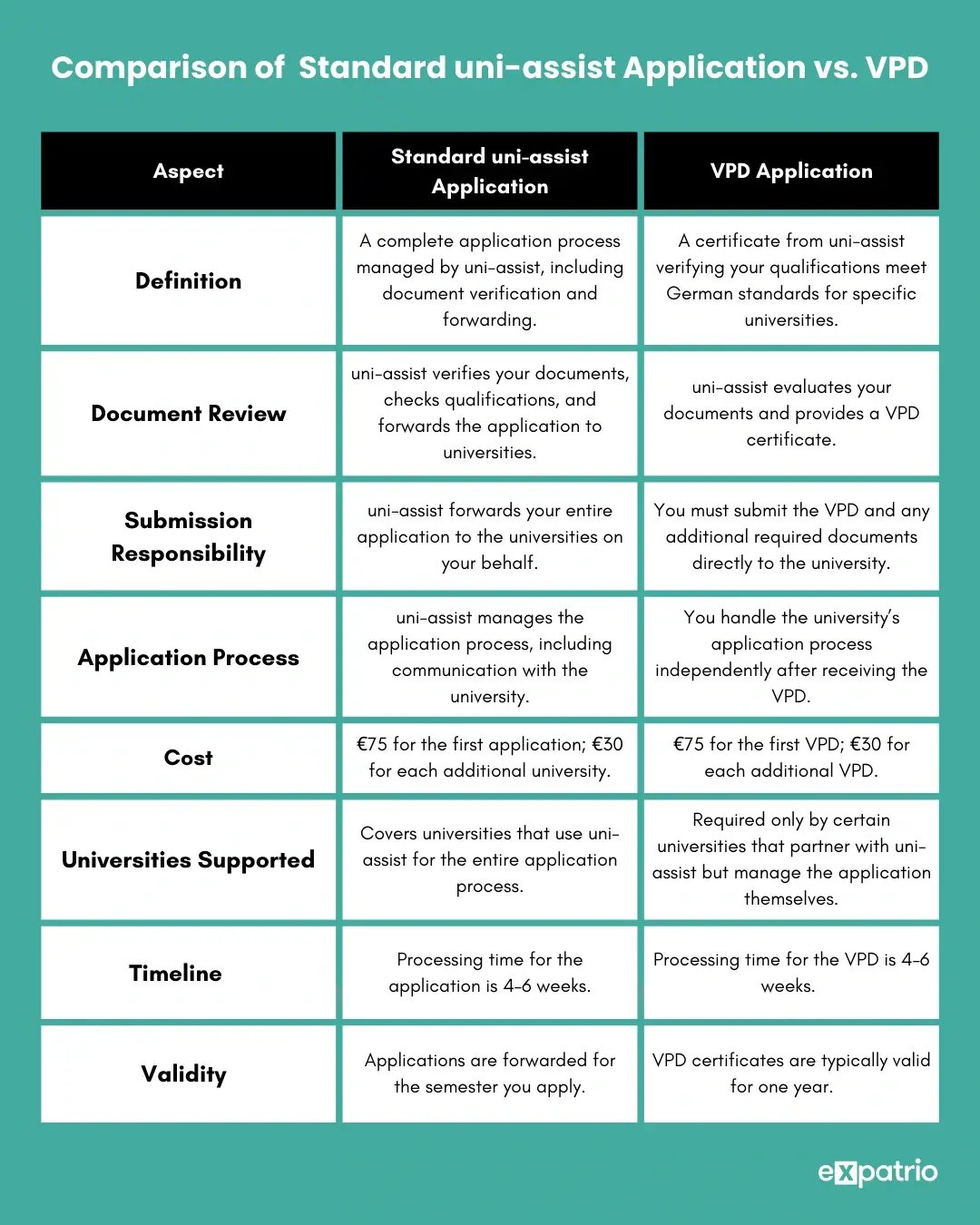
How is a VPD Different from a Standard uni-assist Application?
Your university application can be handled by uni-assist in one of two ways. Depending on the requirements of your university, you may be asked to submit a VPD directly to the university or submit your entire application via uni-assist. Here, we break down the differences between the two processes:
How Much Does a VPD Cost?
The cost of a VPD is similar to that of a regular uni-assist application. Here’s what you need to know:
Fee Structure:
-
First VPD request: €75
-
Any additional VPDs for additional universities: €30 each
Your first application through uni-assist will cost €75. If you apply to additional universities, you'll pay €30 for each extra application, depending on the number of universities you choose.
What Happens After You Receive a VPD?

After uni-assist processes your documents, you’ll receive your VPD certificate. Here’s what you need to do next:
-
Submit the VPD to the university: Once you have the VPD, you must upload or mail it to the university along with any other required documents (such as language certificates, CVs, or letters of motivation).
-
Complete the rest of the application: The VPD is just one part of your application. For any additional steps, make sure you check the university’s specific requirements.
Validity:
-
The VPD is usually valid for one year, so make sure to apply within that period. If it expires, you may need to request a new one.
What Happens if You Don’t Meet the Requirements for a VPD?
If uni-assist determines that your qualifications don’t meet the minimum German standards, they won’t issue a VPD. However, this doesn’t mean the end of your study plans in Germany.
Alternative Options:
-
Studienkolleg: Some universities offer preparatory programs, known as Studienkollegs, for students whose qualifications are not directly equivalent to the German system. However, most of these courses are offered in German only, even if you wish to take a bachelors degree in English later on.
-
Further Study: You may need to complete additional coursework or obtain certifications in your home country to qualify for German university programs in the future.
The Vorprüfungsdokumentation (VPD) is an essential document for many international students applying to German universities and successfully finding their dream course. It serves as a pre-check of your qualifications, ensuring that they meet the standards necessary to study in Germany.
Whether you need a VPD or a full uni-assist application, understanding these processes will help you navigate your way through the application journey smoothly. Remember to research each university’s requirements, plan for the fees, and allow plenty of time for the VPD to be processed so you can submit your complete application on time.
What If You Can’t Afford the uni-assist Fee?
If you’re unable to afford the uni-assist fees, don’t worry—there are a few options to explore:
- Scholarships and Financial Aid Programs:
Some organizations, universities, or governments offer scholarships that cover the cost of the uni-assist application. It's worth researching scholarship programs like DAAD (German Academic Exchange Service) or university-specific aid that may provide fee waivers or reimbursements.
- Fee Waiver Programs:
Certain universities and organizations partner with uni-assist to offer fee waivers for students from specific countries or in particular situations (such as refugees). Check the uni-assist website or your chosen university’s page to see if you qualify for any fee waivers. - Applying to Universities that Don’t Require uni-assist:
Not all German universities use uni-assist. Some allow direct applications without any additional processing fees. If you're on a tight budget, consider applying directly to universities that don't require uni-assist. - Reducing the Number of Applications:
If paying the full fee for multiple universities is a financial burden, consider applying to fewer institutions to reduce costs. Applying to one or two universities through uni-assist may be more manageable, and you can balance this by applying directly to others.
How Long Does uni assist Take to Process Application?

One of the most critical aspects of applying through uni-assist is managing time effectively. The processing time for uni-assist can take anywhere from 4 to 6 weeks, so it’s essential to apply early. Most universities have specific deadlines for uni-assist applications, typically earlier than direct application deadlines.
Important Deadlines:
- Summer Semester: Deadlines usually fall between December and January.
- Winter Semester: Deadlines typically range from June to July.
uni-assist plays a vital role in the German university application process for international students. You can ensure a smoother application journey by following these steps and keeping track of deadlines and fees. Whether you're using uni-assist for multiple applications or comparing it with direct admission, planning ahead will help you maximize your chances of success. We wish you good luck with your applications, and we can’t wait for you to experience your student life in Germany!
FAQs

Cheapest Countries to Study Abroad in 2026
Choosing to study abroad, often far from home and on your own, is one of the bravest decisions you can make. It can change your career, your income,...

Your Path to Study Abroad: A Guide for International Students
Studying abroad is a dream for millions of students. The hard part is knowing where to begin. This guide covers why it is worth it, then walks you...

dMAT Exam for Indian Students: Do You Need It? (Quick Check Tool)
The dMAT is a new test added to the APS process for some Indian students applying for a master's in Germany. It starts with the Summer Semester 2027...

Anabin Database Guide: Check If Your Degree Is Recognized in Germany
If you studied outside Germany, you may need to prove that your university degree is recognized or comparable in Germany. This matters when you apply...

Fully Funded Scholarships for International Students in Germany (2026 Guide)
If you're an international student dreaming of studying in Germany, you've probably heard that German public universities are tuition-free. That's...

Summer Semester in Germany: Your Complete Guide for April 2027 Intake
Missed the October intake to study in Germany? The summer semester (Sommersemester) is your second chance, and it comes with real advantages. Most...

Why More Indian Students Are Choosing Germany Over the USA
In the last decade, Germany has become one of the fastest-growing study destinations for Indian students. While the USA once dominated the dreams of...