
German Grade Converter
Calculate your German grade
Convert your grades to the German system in seconds
-
See your grade in the German 1.0 to 5.0 scale
-
Uses the official Modified Bavarian Formula
-
Works for percentage, GPA, CGPA, UK, and USA grades
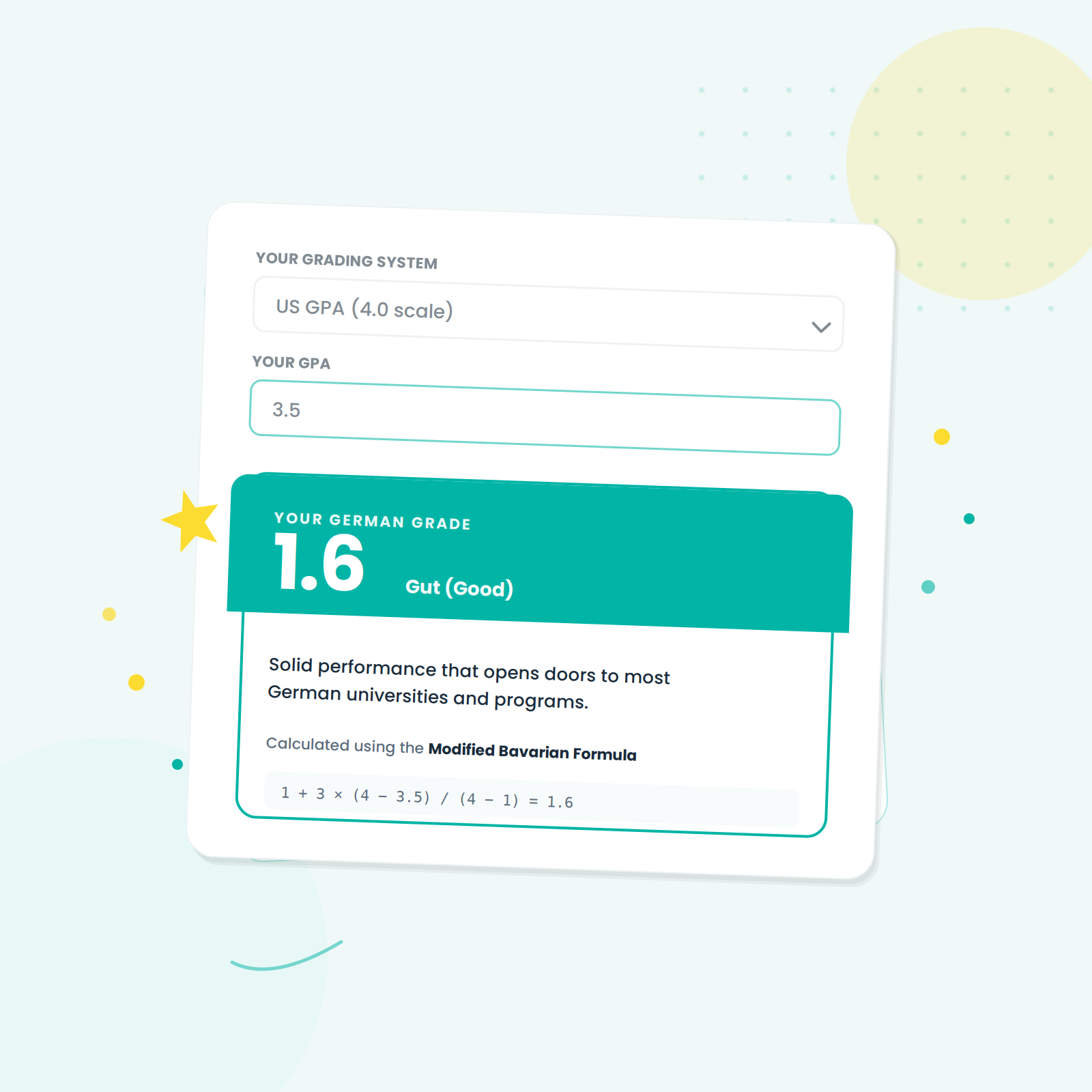
German Grade Converter
Find out how your grade translates to the German grading system used by universities across Germany.
Adjust if your institution uses non-standard maximum or minimum passing grades.
Now find the right program for you. StudyBuddy has 13,000+ options and a quick matching quiz.

Free · 13,000+ programs · Bachelor's & Master's
Frequently asked questions
Who is this tool for?
International students applying to German universities, graduates applying for jobs in Germany where grades are relevant, and anyone curious about how their academic record compares to the German system. It's also useful for preparing documents for uni-assist or understanding scholarship eligibility (for example, DAAD programs that specify grade thresholds).
Is this grade conversion official?
No. This tool gives an approximate conversion for your reference only. Official grade conversions for university applications are typically done by uni-assist or by the admissions office of the specific university you're applying to. Always check the conversion that your target university will use.
Should I convert my grade before applying to a German university?
Not always. Many German universities prefer that you submit your grade in the original grading system of your home country, and they will handle the conversion themselves. Convert your grade only when the university or application platform specifically asks you to, or when you want to understand roughly where your grade falls within the German system. If you apply through uni-assist, they will perform the official conversion as part of their preliminary review.
What is the Modified Bavarian Formula?
It's the standard method used by German universities and uni-assist to convert foreign grades into the German 1.0 to 5.0 scale. The formula is:
German grade = 1 + 3 × (N_max − N_d) / (N_max − N_min)
Where N_max is the highest possible grade in your system, N_min is the lowest passing grade, and N_d is your achieved grade. The Modified Bavarian Formula is recognized by the Kultusministerkonferenz (Conference of Ministers of Education) and is used by uni-assist to evaluate most international transcripts.
What is the German grading scale?
The German grading scale runs from 1.0 (best) to 5.0 (fail). The bands are:
- 1.0 to 1.5: Sehr Gut (Excellent)
- 1.6 to 2.5: Gut (Good)
- 2.6 to 3.5: Befriedigend (Satisfactory)
- 3.6 to 4.0: Ausreichend (Sufficient)
- 5.0: Nicht Ausreichend (Fail)
What should I enter as the minimum passing grade?
Enter the lowest grade that still counts as passing in your system. For example, 40 out of 100 for most UK and Indian universities, 50 out of 100 in some systems, 1.0 for a US undergraduate GPA, or 2.0 for a US graduate GPA. If you're converting your overall degree grade rather than a single module, use the minimum required to pass the degree itself, which is sometimes higher than the per-module pass.
Do all German universities use the same conversion?
No. The Modified Bavarian Formula is the most common method, but universities can have slight modifications. Some use their own conversion tables, and a few use alternative formulas entirely. The result you get here will be close to what most universities calculate, but your official conversion may differ by a small amount.
Is my converted grade competitive for German universities?
It depends on the program. Many German universities are non-selective and require only that you meet the minimum qualifications. Others, particularly selective Master's programs at top universities, have Numerus Clausus (NC) cutoffs that change each year based on the applicant pool. A German grade below 2.5 is generally considered strong for most competitive programs, but requirements vary widely by field and institution.
Does this work for CGPA from Indian universities?
Yes, if you use the Bavarian Formula method. Enter 10 as the maximum grade and your institution's minimum passing CGPA (typically 4.0 or 5.0 depending on the university) as the minimum passing.